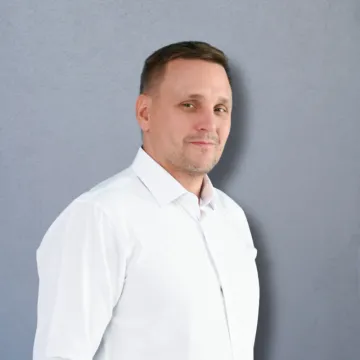
Jan focuses on interdisciplinary research in high-power laser technologies, with an emphasis on their applications in space and defence domains. His expertise spans laser–matter interactions, laser-induced damage threshold (LIDT) physics, and the development of robust photonic systems designed to operate in extreme and mission-critical environments. He works at the interface between fundamental research and applied engineering, aiming to deliver laser-based solutions for communication, propulsion, remote energy transfer, advanced manufacturing, and threat mitigation.
At the HiLASE Centre he serves as Research & Development Coordinator for Space and Defence Applications, leading strategic initiatives focused on adapting and qualifying advanced laser technologies for aerospace and security use cases. His work builds on extensive experience in laser durability testing and laser system design, extending into complex operational environments such as vacuum, thermal extremes, radiation exposure, and atmospheric turbulence.
He gained this experience through more than a decade as Head of the Laser-Induced Damage Threshold (LIDT) Laboratory at the HiLASE Centre, where he led a team of researchers in building the LIDT testing station, developing assessment methods for challenging environments, and providing testing services to commercial partners.
Before joining the HiLASE Centre, he served as National Secretary at the Czech Office for Standardization, Metrology and Testing and held various positions in private ventures within the electronics, photonics, and laser technology sectors. After completing his Ph.D., he spent one year as a Marie Curie Postdoctoral Fellow at FORTH-IESL in Greece, conducting research on the optical properties of photonic crystal fibers and superparamagnetic nanoclusters.
Awards & Recognitions
The Industrial Laser Applications Department focuses on transferring cutting-edge laser technologies into real industrial use. Its activities include advanced materials processing such as laser micromachining, surface structuring, laser cleaning, and laser shock peening. The team develops customized solutions for partners across sectors including aerospace, automotive, energy, and medical engineering.
By combining high-power and high-energy laser systems with deep expertise in industrial processes, the department bridges the gap between fundamental research and practical applications. It also collaborates closely with international companies and research organizations, aiming to strengthen competitiveness and drive innovation through laser-based technologies.
The HiLASE Centre offers an internship for candidates interested in advanced laser technologies for precision, long-range, line-of-sight applications. This role provides hands-on experience in optical design, end-to-end propagation modeling, and experimental validation within a high-tech photonics environment.
Key Duties:
Core Skills
Valued Skills
Optional Skills
From June 15 to August 31, 2026 (adjustable at the discretion of the organisation)
The Industrial Laser Applications Group focuses on transferring cutting-edge laser technologies into real industrial use. Its activities include advanced materials processing such as laser micromachining, surface structuring, laser cleaning, and laser shock peening. The team develops customized solutions for partners across sectors including aerospace, automotive, energy, and medical engineering.
By combining high-power and high-energy laser systems with deep expertise in industrial processes, the group bridges the gap between fundamental research and practical applications. It also collaborates closely with international companies and research organizations, aiming to strengthen competitiveness and drive innovation through laser-based technologies.
The HiLASE Centre offers an internship for candidates excited by the intersection of advanced laser technologies and space resource utilization. This position provides hands-on experience in technology scouting, experiment design, and stakeholder mapping within a high-tech photonics environment focused on in-situ resource utilization (ISRU) for the Moon, Mars, and small bodies.
Key Responsibilities
This internship is ideal for students or recent graduates in optics, photonics, physics, aerospace engineering, materials science, robotics, or planetary/geosciences. Candidates from business, economics, or international relations with strong technical curiosity about space resources are also welcome.
Core Requirements
Valued Skills
Helpful Skills
From June 15 to August 31, 2026 (adjustable at the discretion of the organisation)