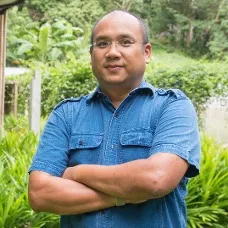
Dr. Thanapong Duangmanee is an environmental engineer and sustainability leader with more than 15 years of experience at the Mae Fah Luang Foundation. As the Director of Environmental Policy, he oversees a team of about 40 professionals and guides the Foundation’s environmental strategy across a wide range of initiatives.
His work spans circular economy design and performance measurement, zero-waste-to-landfill operations, wastewater treatment and reuse, and the utilization of renewable energy sources such as macadamia shells. He also leads efforts in biochar production from leftover bamboo, forest-based carbon credit project development, water footprint assessment, product carbon footprint calculation, and biodiversity conservation.
In addition to managing these technical programs, Dr. Thanapong plays a key role in shaping the Foundation’s long-term climate strategy. He directs the development of Net Zero policies for both the Foundation and its private-sector partners, ensuring that emissions reduction goals are practical, science-based, and measurable. He also leads the Foundation’s consultant and verifier team for the Carbon Footprint of Organization (CFO) and Thailand Voluntary Emission Reduction (T-VER) programs, supporting organizations in accurately assessing and meaningfully reducing their environmental impact.
Each year, his team hosts 6 to 10 students from Thailand and abroad. He aims for every student to conduct an individual project while also gaining meaningful exposure to Thai culture and local communities.
【Work Experience】
【Awards】
【Environment Policy Development】
The department consists of roughly 40 dedicated professionals who contribute their expertise across a wide range of environmental and sustainability-related fields. Each team member plays a vital role in ensuring that the department can effectively address complex ecological challenges and support long-term organizational goals. Their work spans several key areas, beginning with waste management and wastewater treatment, both of which are essential for reducing environmental pollution and ensuring the responsible handling of industrial and community-generated waste. The department is also responsible for monitoring and supporting compliance with environmental standards, helping organizations meet national and international regulations.
In addition, the team specializes in calculating carbon footprints for both products and entire organizations. This includes assessing emissions across supply chains and identifying opportunities to reduce environmental impact. They also conduct water footprint assessments to better understand water usage and promote efficient resource management. The department is actively involved in renewable energy utilization and Net Zero strategic planning, guiding organizations toward low-carbon pathways.
Beyond these functions, the team is also involved in biochar production and the development of carbon credits across the forestry, agriculture, energy, and waste sectors. In addition, some team members serve as verifiers for domestic standards. They also conduct biodiversity surveys to support conservation efforts and ensure sustainable ecosystem management.
PM2.5 air pollution has been a long-standing environmental and public health concern for communities in northern Thailand. Much of this pollution comes from the open burning of agricultural waste, including corn stalks, rice straw, dry leaves, and other leftover biomass that farmers traditionally dispose of through open burning. This practice contributes significantly to seasonal haze, reduced air quality, and health risks for local residents. At the same time, many of these communities face rising energy prices and limited access to affordable, reliable, and clean energy sources.
The internship focuses on addressing both challenges through practical, community-centered solutions. You will work on developing or applying existing technologies to convert leftover biomass in the Doi Tung area—such as fallen leaves, macadamia shells, and other agricultural residues—into useful forms of energy. This may include exploring methods like biochar production, biomass briquetting, small-scale gasification, or other energy conversion approaches suitable for local use.
By turning waste into energy, the goal is to reduce the need for open burning, thereby cutting PM2.5 emissions, while simultaneously providing the community with cleaner and more sustainable energy options. Your work will contribute directly to improving air quality, enhancing local energy resilience, and supporting broader decarbonization efforts in the region.
From June 15 to August 31, 2026 (adjustable at the discretion of the organisation)
【Environment Policy Development】
The department consists of roughly 40 dedicated professionals who contribute their expertise across a wide range of environmental and sustainability-related fields. Each team member plays a vital role in ensuring that the department can effectively address complex ecological challenges and support long-term organizational goals. Their work spans several key areas, beginning with waste management and wastewater treatment, both of which are essential for reducing environmental pollution and ensuring the responsible handling of industrial and community-generated waste. The department is also responsible for monitoring and supporting compliance with environmental standards, helping organizations meet national and international regulations.
In addition, the team specializes in calculating carbon footprints for both products and entire organizations. This includes assessing emissions across supply chains and identifying opportunities to reduce environmental impact. They also conduct water footprint assessments to better understand water usage and promote efficient resource management. The department is actively involved in renewable energy utilization and Net Zero strategic planning, guiding organizations toward low-carbon pathways.
Beyond these functions, the team is also involved in biochar production and the development of carbon credits across the forestry, agriculture, energy, and waste sectors. In addition, some team members serve as verifiers for domestic standards. They also conduct biodiversity surveys to support conservation efforts and ensure sustainable ecosystem management.
The Doi Tung Development Project welcomes interns who wish to work on water footprint assessments for community products. This internship focuses on analyzing how much water is used throughout the production of one coffee product. Interns will collect data at production sites, interview community members, and document every stage of the process to understand direct and indirect water use. They will apply established water footprint methodologies to evaluate impacts and identify opportunities for improvement. The results will support the Foundation’s efforts to promote sustainable resource management and help community enterprises to reduce water consumption while maintaining product quality. Interns will gain practical experience in environmental assessment, data analysis, and fieldwork within community settings. Beyond technical learning, they will also engage with the Doi Tung community, gaining insights into local culture, traditional techniques, and the social benefits linked to sustainable development. This experience provides a valuable opportunity for students to strengthen their skills, contribute to environmental responsibility, and support the Foundation’s mission to create resilient, environmentally conscious, and community-driven production systems. Interns are encouraged to share their findings widely to increase awareness and sustainably support ongoing improvements in community practices.
From June 15 to August 31, 2026 (adjustable at the discretion of the organisation)